

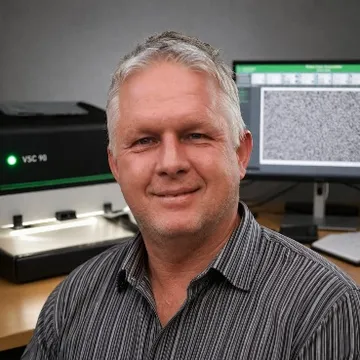
Col (ret'd) Marthinus T. du Toit
Forensic Document & Handwriting Expert · Gauteng
29+ years' experience in forensic document examination with the South African Police Service.
Unlocking Truth, Protecting Integrity
Independent, court-ready examination of questioned documents, handwriting and signatures by two retired SAPS colonels with more than 64 years' combined experience.
Each instruction is assessed on its own facts, the material available and what a forensic examination can reliably answer.
Is the signature genuine? Who wrote it? Comparison of questioned handwriting and signatures with known specimens.
Learn moreDetection of forgeries, erasures, additions and page substitution, and deciphering of obscured or overwritten entries.
Learn moreRecovery of invisible writing impressions left on pages underneath, using an Electrostatic Detection Apparatus.
Learn moreExamination of documents from printers, photocopiers and fax machines, and of rubber stamps and the instruments that made them.
Learn moreAuthentication of banknotes of all currencies and examination of paper-based security features such as microdots.
Learn moreAny other forensic document-related question falling within the recognised scope of forensic document examination. If you are unsure whether we can help, ask us.
Ask an expertA clear, documented process protects the evidence and the integrity of the findings.
Call, email or use the contact form. We will discuss the question and what material is needed.
Upload scans on our secure upload page for a first look at suitability, scope and cost.
You receive a quotation. Originals are delivered under chain of custody once you instruct us.
The examination is documented, peer reviewed and reported clearly. We can testify if required.
Both examiners spent their careers in forensic document examination with the South African Police Service: casework, expert testimony, case review, research and national training.
29+ years' experience in forensic document examination with the South African Police Service.
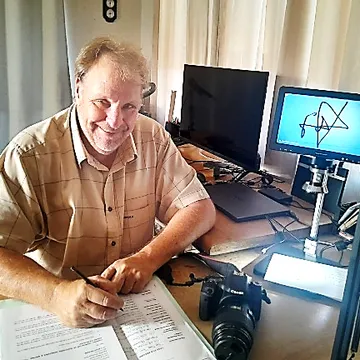
35+ years' experience in forensic document examination with the South African Police Service.
Examinations follow recognised standards and use specialised equipment, so that every conclusion can be explained, tested and defended.
Attorneys and advocates in criminal, civil and estate matters.
Government departments, investigative and prosecuting authorities.
Disputed mandates, cheques, claims and policy documents.
Internal investigations, disciplinary matters and fraud.
Fraud investigators and forensic accounting teams.
Wills, estates, property and family matters.
Workshops, seminars and in-house programmes for legal practitioners, investigators, auditors, banks and insurers, plus specialised training for document examiners.
View trainingPre-trial consultation, case strategy, interpretation of expert reports and preparation for cross-examination of document experts.
How we helpA forensic document examiner scientifically examines documents whose authenticity, origin or history is in dispute. This includes identifying who wrote handwriting or a signature, detecting forgeries and alterations, recovering indented writing, and examining printing, stamps and security features. Findings are set out in a written report that can be used in court.
A first assessment can usually be made from good-quality scans or photographs, which you can upload on our secure Submit Documents page. Copies have limits: pen pressure, indented writing, inks, erasures and paper or printing features can be lost when a document is copied. After the first assessment we tell you whether copies are enough or the originals are needed, and any limits are stated in the report.
It depends on the nature, complexity and scope of the matter, and on the quality of the documents and comparison specimens. After a first assessment we give you an estimated turnaround time. Urgent matters can be expedited, subject to availability, the nature of the matter and the material provided.
Fees are charged hourly or by quotation. The cost depends on the number of documents and specimens, the complexity of the examination, travel, reporting and consultation, and any court attendance. Send us the details or upload scans, and after a first assessment we give you a quotation or an indication of fees and expenses.
Yes. Reports are prepared with reference to the ENFSI Best Practice Manual and the ISO 21043 forensic science standards, using the ACE-V method, for criminal, civil, disciplinary and administrative proceedings. Our examiners can present and defend their findings in court as expert witnesses.
No. Marthinus du Toit is based in Pretoria / Centurion and covers Gauteng, including Johannesburg, Sandton, Midrand and the East and West Rand. Marco van der Hammen is based in Umkomaas and covers KwaZulu-Natal, from Durban and the South Coast to Pietermaritzburg, Richards Bay and Newcastle. We travel anywhere in South Africa, and also work in Africa and internationally.
No. We do not do graphology. Graphology claims to assess personality from handwriting and is not accepted as evidence in court. Forensic handwriting analysis, or handwriting examination, is a comparative, scientific discipline focused on identifying the writer and testing whether writing or a signature is genuine.
Tell us about the matter. We will advise on what is needed, what an examination can answer, and the likely cost.
Chat on WhatsApp
Choose the examiner nearest to you. We reply in English or Afrikaans.
GautengCol (ret'd) Marthinus T. du ToitKwaZulu-NatalCol (ret'd) Marco C. van der Hammen